Core Router #
Purpose #
The core router is the production network authority for each Deevnet site. It provides routing, firewall, DNS, DHCP, and gateway services for all substrate hosts.
graph LR
    A[Edge Router
unmanaged] <--> B[Core Router
managed] <--> C[Site Hosts]
Hardware Platforms #
Site: mobile (mobile) Active
The ZimaBoard 832 is a compact x86 single-board server used as the core router for the mobile site. Its low power consumption and passive cooling make it ideal for portable deployments.

Hardware #
| Attribute | Value |
|---|---|
| Model | ZimaBoard 832 |
| CPU | Intel Celeron N3450 quad-core (1.1-2.2GHz) |
| Memory | 8GB LPDDR4 |
| Storage | 32GB eMMC |
| Ethernet | 2x Gigabit LAN |
| Expansion | PCIe x4, 2x SATA 6.0 Gb/s |
| USB | 2x USB 3.0 |
| Video | Mini DisplayPort (4K/60Hz) |
| Power | 6W TDP, 12V DC barrel jack |
| Cooling | Passive (aluminum case heatsink) |
Selection Rationale #
- Compact x86 form factor fits mobile site
- Dual Gigabit Ethernet for WAN/LAN separation
- Low power consumption (<6W TDP) suitable for always-on operation
- Passive cooling (fanless, silent) for noise-sensitive environments
- x86 architecture supports OPNsense natively
Site: home (home) Active
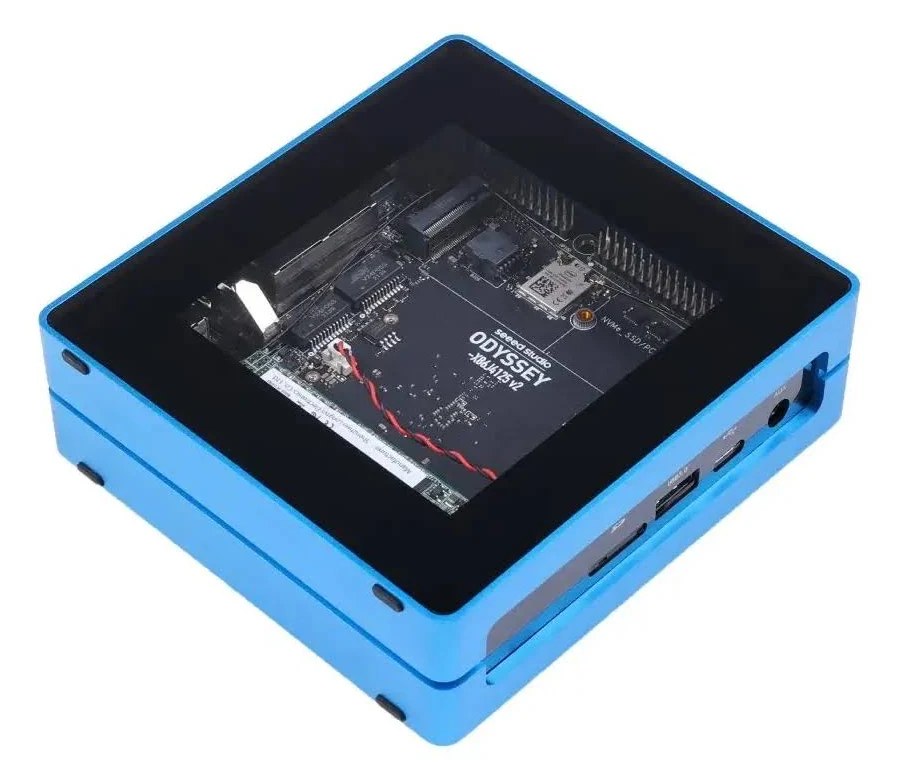
The ODYSSEY X86J4125864 is an x86 single-board computer used as the core router for the home site. It provides more compute headroom and expansion options compared to the mobile router.
Hardware #
| Attribute | Value |
|---|---|
| Model | ODYSSEY X86J4125864 |
| CPU | Intel Celeron J4125 quad-core (2.0-2.7GHz) |
| Memory | 8GB LPDDR4 |
| Storage | 64GB eMMC |
| Ethernet | 2x Gigabit LAN (Realtek) |
| Expansion | M.2 B-Key, M.2 M-Key, SATA III |
| USB | 4x USB (2x USB 3.0, 2x USB 2.0) |
| Video | HDMI 2.0a + DP 1.2a (4K/60Hz) |
| Wireless | Wi-Fi 802.11ac, Bluetooth 5.0 |
| Power | ~10-12W typical, 12V DC |
| Cooling | Active (included fan) |
| Co-processor | ATSAMD21 (Arduino compatible) |
Selection Rationale #
- Dual Gigabit Ethernet for WAN/LAN separation
- x86 architecture supports OPNsense natively
- Sufficient compute for home network routing
- M.2 slots for expansion (future 10GbE, NVMe)
- eMMC storage for reliable boot
Operating System #
Both core routers run OPNsense, providing a consistent firewall and routing platform across sites.
| Attribute | Value |
|---|---|
| OS | OPNsense |
| Version | 24.x |
| Base | FreeBSD |
Roles #
| Role | Description |
|---|---|
| DNS Forwarding | Forwards DNS queries to upstream resolver |
| DHCP | Static mappings for known hosts, pool for dynamic clients |
| NAT | Masquerades substrate traffic to upstream |
| Wake-on-LAN | WoL proxy for substrate hosts |
| Gateway | Default route for all substrate traffic |
Configuration Management #
Configured via the deevnet.net Ansible collection:
| Component | Management |
|---|---|
| DNS records | Pushed from inventory |
| DHCP static mappings | Pushed from inventory |
| Firewall rules | Defined in playbooks |
| WoL targets | Defined in inventory |
DNS: Unbound #
Three distinct collections, reconciled from inventory by the opnsense_dns role:
| What | OPNsense feature | Used for |
|---|---|---|
| Address records | Host override | host.mobile.deevnet.net → address |
| Aliases | Host alias | Service names pointing at a host — stored as CNAMEs |
| Zone forwards | Query Forwarding | Sending a tenant zone to the tenant authoritative service |
The API shape for Query Forwarding is not where you would look for it, verified on 25.7.10.
These rows are not part of unbound/settings/get — that payload’s keys are general, advanced,
acls, dnsbl, forwarding, dots, hosts, aliases, and forwarding is the use system
nameservers toggle rather than a collection. Forward rows have their own endpoints and are wrapped
in a dot object that backs both DNS-over-TLS and plain rows:
POST /api/unbound/settings/searchForward
POST /api/unbound/settings/addForward
POST /api/unbound/settings/setForward/<uuid>
POST /api/unbound/settings/delForward/<uuid>

body: {"dot": {"enabled": "1", "type": "forward",
               "domain": "...", "server": "...", "description": "..."}}
type must be forward. The default would attempt DNS-over-TLS against an authoritative server on
port 53.
Changes land in the saved configuration only; the running resolver is not updated until
POST /api/unbound/service/reconfigure.
Because these are forwards rather than referrals, the resolver never consults the tenant zone’s own apex records — see Naming and Addressing for what that changes.
DHCP: Kea #
Reservations are generated from inventory and keyed on each host’s declared hardware address, which
makes the MAC load-bearing: a guest whose NIC does not carry its declared address does not match its
reservation and silently receives a pool address instead. On the management segment the pool begins
at .200, so that failure shows up as a host sitting somewhere in the .200+ range with no name
pointing at it.
The platform segment has reservations only and no pool at all.
Authority Transition #
Per the Correctness Standard:
- During initial provisioning, the bootstrap node provides DNS/DHCP
- Core router is provisioned and configured via Ansible
- Authority explicitly transitions to core router
- Bootstrap node’s dnsmasq is disabled
- Core router becomes the production DNS/DHCP server
This transition is explicit, not automatic. Running two DNS/DHCP authorities simultaneously will cause conflicts.